- Contents Page
- Preface
- Introduction
- Signs
- Modality and representation
- Paradigms and syntagms
- Syntagmatic analysis
- Paradigmatic analysis
- Denotation, connotation and myth
- Rhetorical tropes
- Codes
- Modes of address
- Encoding/Decoding
- Articulation
- Intertextuality
- Criticisms of semiotic analysis
- Strengths of semiotic analysis
- D.I.Y. semiotic analysis
- Glossary of key terms
- Suggested reading
- References
- Index
- Semiotics links
- S4B Message Board
- S4B Chatroom
Semiotics for Beginners
Daniel Chandler
Key Figures
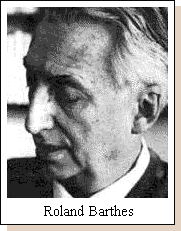 Barthes, Roland (1915-80) was a prominent French literary scholar, cultural theorist and semiotician.
In 1976 he became the first person to hold the chair of 'literary semiology' at the Collège de France
(his final post). Barthes' approach to cultural criticism evolved from a structuralism influenced by
Saussure and the Danish linguist Louis Hjelmslev (1899-1966) into a more poststructuralist inflection.
Whilst deriving his structuralist approach primarily from linguistics Barthes went beyond Saussure's
focus on purely verbal signs, applying it to a wide range of social phenomena. The Saussurean legacy of
the arbitrariness of signs has led many semioticians to stress that even signs which appear 'transparent' -
such as in photography and film-are dependent on social and cultural conventions (or codes) which have to be
learned before such signs can be 'read'. Barthes' best-known work is Mythologies, 1957 (abridged English
translation 1973)- a collection of essays examining taken-for-granted assumptions embedded in popular culture.
His early work was largely responsible for establishing structuralist semiotics as a major approach to
reading cultural practices amongst cultural theorists. He formally outlined the structuralist
Eléments de sémiologie, 1964 (Elements of Semiology 1967) and applied this method in
Système de la mode, 1967
(The Fashion System 1983). These two works focused on formal structural analysis, but in much of his work the
reading of textual and social codes was a tool for a loosely neo-Marxist ideological analysis-serving to
unmask what he saw as the dominant social values of the bourgeoisie. Barthes adopted from Hjelmslev the notion
that there are different orders of signification (levels of meaning) in semiotic systems. The first is that of
denotation: at this level there is a sign consisting of a signifier and a signified. Connotation is a second-order
which uses the denotative sign as its signifier and attaches to it an additional signified. Barthes argues that
these orders combine to produce ideology in the form of myth, which serves the ideological function of naturalisation
- in other words, making dominant cultural and historical values, attitudes and beliefs seem entirely 'natural',
normal, self-evident, timeless, obvious commonsense- and thus objective and true reflections of 'the way things
are'. Despite an oft-quoted assertion in 'Le message photographique', 1961 ('The photographic message' in
Image-Music-Text 1977) that 'the photographic image... is a message without a code', Barthes went on to
argue that the apparent identity of the signifier and the signified in this medium is a powerful illusion.
No sign is purely denotative- lacking connotation- 'Every sign supposes a code'.
Whilst Saussure argued for the arbitrariness of the relationship between the signifier and the signified,
poststructuralists assert their total disconnection. The advent of poststructuralism is often associated with the
publication of Roland Barthes's S/Z in 1970 (English translation 1974). Barthes refers to an 'empty signifier' in
'Le Mythe aujourd'hui', 1957 ('Myth Today' in Mythologies). In later work he shows a poststructuralist concern both
for what became known as 'intertextuality' (the text as 'a tissue of quotations') and for the reader as 'a producer
of the text'- heralding 'La mort de l'auteur' ('The death of the author' in Image-Music-Text, 1968).
Barthes, Roland (1915-80) was a prominent French literary scholar, cultural theorist and semiotician.
In 1976 he became the first person to hold the chair of 'literary semiology' at the Collège de France
(his final post). Barthes' approach to cultural criticism evolved from a structuralism influenced by
Saussure and the Danish linguist Louis Hjelmslev (1899-1966) into a more poststructuralist inflection.
Whilst deriving his structuralist approach primarily from linguistics Barthes went beyond Saussure's
focus on purely verbal signs, applying it to a wide range of social phenomena. The Saussurean legacy of
the arbitrariness of signs has led many semioticians to stress that even signs which appear 'transparent' -
such as in photography and film-are dependent on social and cultural conventions (or codes) which have to be
learned before such signs can be 'read'. Barthes' best-known work is Mythologies, 1957 (abridged English
translation 1973)- a collection of essays examining taken-for-granted assumptions embedded in popular culture.
His early work was largely responsible for establishing structuralist semiotics as a major approach to
reading cultural practices amongst cultural theorists. He formally outlined the structuralist
Eléments de sémiologie, 1964 (Elements of Semiology 1967) and applied this method in
Système de la mode, 1967
(The Fashion System 1983). These two works focused on formal structural analysis, but in much of his work the
reading of textual and social codes was a tool for a loosely neo-Marxist ideological analysis-serving to
unmask what he saw as the dominant social values of the bourgeoisie. Barthes adopted from Hjelmslev the notion
that there are different orders of signification (levels of meaning) in semiotic systems. The first is that of
denotation: at this level there is a sign consisting of a signifier and a signified. Connotation is a second-order
which uses the denotative sign as its signifier and attaches to it an additional signified. Barthes argues that
these orders combine to produce ideology in the form of myth, which serves the ideological function of naturalisation
- in other words, making dominant cultural and historical values, attitudes and beliefs seem entirely 'natural',
normal, self-evident, timeless, obvious commonsense- and thus objective and true reflections of 'the way things
are'. Despite an oft-quoted assertion in 'Le message photographique', 1961 ('The photographic message' in
Image-Music-Text 1977) that 'the photographic image... is a message without a code', Barthes went on to
argue that the apparent identity of the signifier and the signified in this medium is a powerful illusion.
No sign is purely denotative- lacking connotation- 'Every sign supposes a code'.
Whilst Saussure argued for the arbitrariness of the relationship between the signifier and the signified,
poststructuralists assert their total disconnection. The advent of poststructuralism is often associated with the
publication of Roland Barthes's S/Z in 1970 (English translation 1974). Barthes refers to an 'empty signifier' in
'Le Mythe aujourd'hui', 1957 ('Myth Today' in Mythologies). In later work he shows a poststructuralist concern both
for what became known as 'intertextuality' (the text as 'a tissue of quotations') and for the reader as 'a producer
of the text'- heralding 'La mort de l'auteur' ('The death of the author' in Image-Music-Text, 1968).
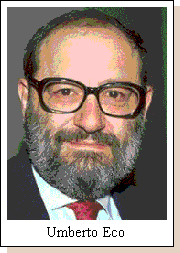 Eco, Umberto (b. 1932), an Italian semiotician and novelist, took up a post as Associate Professor of
Semiotics at
the University of Bologna In 1971. In 1974 he organised the first congress of the International Association for
Semiotic Studies and he became a full Professor of Semiotics the next year. Published in 1980, his novel
Il nome della rosa (The Name of the Rose)-
a murder mystery which reflects both his semiotic and medieval interests- rapidly
became an international bestseller and a film, and by 1985 Eco was being showered with honorary doctorates from
universities around the world. This celebrity semiotician (a unique oxymoron) believes that mainstream contemporary
philosophy should not sideline semiotics. In Trattato di semiotica generale, 1975
(A Theory of Semiotics, 1976) he
declared that 'semiotics is concerned with everything that can be taken as a sign'. In this work he sought to
combine aspects of European structuralism and of the semiotics of the American philosopher Charles Sanders Peirce
(1839-1914). One of Eco's central concerns is reflected in the English title of Lector in Fabula
(The Role of the Reader 1979). As Peirce had noted, a sign is not a sign until it is interpreted- a notion pursued further in Eco's
(1984) Semiotica e filosofia del linguaggio (Semiotics and the Philosophy of Language).
Whilst Saussure had
established that signs always relate to other signs, within his model the relationship between signifier and
signified was stable and predictable. Drawing upon Peirce's notion of the 'interpretant', Eco coined the term
'unlimited semiosis' to refer to the way in which the signified can function in its turn as a signifier for a
further signified. 'Open' texts can have multiple interpretations (although unlike many postmodernists Eco regards
such interpretations as subject to constraints). He sees textual constraints as demanding a detective reader seeking
an interpretation justified by the evidence. Like the structuralist semioticians Eco also locates signs within codes-
to which the interpretation of signs requires reference. These include both denotative and connotative codes. Eco's
codes are more open, dynamic and related to social context than conventional structuralist models; meaning is
dependent on users' variable competence in using codes and subcodes. 'Aberrant decoding' occurs when a text is
decoded by means of a different code from that used to encode it. A Theory of Semiotics should be read in
conjunction with Kant e l'ornitorinco, 1997 (Kant and the Platypus, 1999)-an exploration of the
relationship
between language, cognition and reality. Eco has declared that his abiding concern is with the ways in which we
give meaning to the world. In a stance which critics interpret as idealism but which does not, as Saussure had
done, 'bracket' reference to a world beyond the sign system, Eco insists that language does not merely mediate
reality but is involved in its construction. Hence his provocative declaration that 'semiotics is in principle
the discipline studying everything which can be used in order to lie'.
Eco, Umberto (b. 1932), an Italian semiotician and novelist, took up a post as Associate Professor of
Semiotics at
the University of Bologna In 1971. In 1974 he organised the first congress of the International Association for
Semiotic Studies and he became a full Professor of Semiotics the next year. Published in 1980, his novel
Il nome della rosa (The Name of the Rose)-
a murder mystery which reflects both his semiotic and medieval interests- rapidly
became an international bestseller and a film, and by 1985 Eco was being showered with honorary doctorates from
universities around the world. This celebrity semiotician (a unique oxymoron) believes that mainstream contemporary
philosophy should not sideline semiotics. In Trattato di semiotica generale, 1975
(A Theory of Semiotics, 1976) he
declared that 'semiotics is concerned with everything that can be taken as a sign'. In this work he sought to
combine aspects of European structuralism and of the semiotics of the American philosopher Charles Sanders Peirce
(1839-1914). One of Eco's central concerns is reflected in the English title of Lector in Fabula
(The Role of the Reader 1979). As Peirce had noted, a sign is not a sign until it is interpreted- a notion pursued further in Eco's
(1984) Semiotica e filosofia del linguaggio (Semiotics and the Philosophy of Language).
Whilst Saussure had
established that signs always relate to other signs, within his model the relationship between signifier and
signified was stable and predictable. Drawing upon Peirce's notion of the 'interpretant', Eco coined the term
'unlimited semiosis' to refer to the way in which the signified can function in its turn as a signifier for a
further signified. 'Open' texts can have multiple interpretations (although unlike many postmodernists Eco regards
such interpretations as subject to constraints). He sees textual constraints as demanding a detective reader seeking
an interpretation justified by the evidence. Like the structuralist semioticians Eco also locates signs within codes-
to which the interpretation of signs requires reference. These include both denotative and connotative codes. Eco's
codes are more open, dynamic and related to social context than conventional structuralist models; meaning is
dependent on users' variable competence in using codes and subcodes. 'Aberrant decoding' occurs when a text is
decoded by means of a different code from that used to encode it. A Theory of Semiotics should be read in
conjunction with Kant e l'ornitorinco, 1997 (Kant and the Platypus, 1999)-an exploration of the
relationship
between language, cognition and reality. Eco has declared that his abiding concern is with the ways in which we
give meaning to the world. In a stance which critics interpret as idealism but which does not, as Saussure had
done, 'bracket' reference to a world beyond the sign system, Eco insists that language does not merely mediate
reality but is involved in its construction. Hence his provocative declaration that 'semiotics is in principle
the discipline studying everything which can be used in order to lie'.
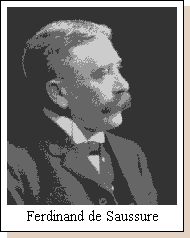 Saussure, Ferdinand de (1857-1913), Swiss-born founder of modern linguistics, was a pioneer of structuralist
thinking- his was the linguistic model which inspired the European structuralists. The
Cours de linguistique générale
(Course in General Linguistics, 1959) was first published posthumously in 1916 from student notes on his courses
(1906-11). Although the words 'structure' and 'structuralism' are not mentioned, the Cours
is the source of much of
the terminology of structuralism. It is here that Saussure envisaged the establishment of sémiologie ('semiology')
as 'a science which studies the role of signs as part of social life'. It was left to later scholars to study the
social use of signs, however. To Saussure (and to most subsequent structuralists) what mattered most were the
underlying structures and rules of the semiotic system as a whole (langue) rather than specific performances or
practices which were merely instances of its use (parole). Furthermore, Saussure prioritised studying such a system
synchronically (as it exists as a relatively stable system during a certain period) rather than diachronically
(studying its evolution).
Saussure offered a dyadic model of the sign- in contrast to the triadic model of the American philosopher Charles
Sanders Peirce (1839-1914). Focusing on linguistic signs (in particular spoken words), Saussure defined a sign as
composed of a signifiant ('signifier' or 'sound pattern') and a signifié ('signified' or 'concept').
Subsequent commentators now commonly interpret the signifier as the material (or physical) form of the sign-
as something which
can be seen, heard, touched, smelt or tasted. Unlike Peirce, Saussure 'brackets the referent': excluding direct
reference to a world beyond the sign system. Saussure's conception of meaning was purely structural and relational
rather than referential- signs refer primarily to each other. These functional relations are of two kinds:
syntagmatic (concerning positioning) and associative (concerning substitution), the latter now called 'paradigmatic'
in accordance with the usage of the Russian linguist Roman Jakobson (1896-1982). Saussure distinguished the value of
a sign from its signification or referential meaning. Even those words in different languages which have equivalent
referential meanings have different values since they belong to different networks of associations.
Saussure stressed the arbitrariness of the link between the linguistic signifier and the signified. There is no
inherent, essential, transparent, self-evident or natural connection between the signifier and the signified-
between the sound (or shape) of a word and the concept to which it refers. The Saussurean model, with its emphasis
on internal structures within a sign system and on the arbitrariness of the sign can be seen as consonant with the
stance that language does not 'reflect' reality but rather constructs it. Taking this together with its asocial and
ahistorical focus on langue and synchronicity, the Saussurean model has criticised as idealist.
There are two English translations of Saussure (Baskin 1959 and Harris 1983) though in the latter note the
substitution of 'signal' and 'signification' for what are still invariably known as the signifier and the
signified.
Saussure, Ferdinand de (1857-1913), Swiss-born founder of modern linguistics, was a pioneer of structuralist
thinking- his was the linguistic model which inspired the European structuralists. The
Cours de linguistique générale
(Course in General Linguistics, 1959) was first published posthumously in 1916 from student notes on his courses
(1906-11). Although the words 'structure' and 'structuralism' are not mentioned, the Cours
is the source of much of
the terminology of structuralism. It is here that Saussure envisaged the establishment of sémiologie ('semiology')
as 'a science which studies the role of signs as part of social life'. It was left to later scholars to study the
social use of signs, however. To Saussure (and to most subsequent structuralists) what mattered most were the
underlying structures and rules of the semiotic system as a whole (langue) rather than specific performances or
practices which were merely instances of its use (parole). Furthermore, Saussure prioritised studying such a system
synchronically (as it exists as a relatively stable system during a certain period) rather than diachronically
(studying its evolution).
Saussure offered a dyadic model of the sign- in contrast to the triadic model of the American philosopher Charles
Sanders Peirce (1839-1914). Focusing on linguistic signs (in particular spoken words), Saussure defined a sign as
composed of a signifiant ('signifier' or 'sound pattern') and a signifié ('signified' or 'concept').
Subsequent commentators now commonly interpret the signifier as the material (or physical) form of the sign-
as something which
can be seen, heard, touched, smelt or tasted. Unlike Peirce, Saussure 'brackets the referent': excluding direct
reference to a world beyond the sign system. Saussure's conception of meaning was purely structural and relational
rather than referential- signs refer primarily to each other. These functional relations are of two kinds:
syntagmatic (concerning positioning) and associative (concerning substitution), the latter now called 'paradigmatic'
in accordance with the usage of the Russian linguist Roman Jakobson (1896-1982). Saussure distinguished the value of
a sign from its signification or referential meaning. Even those words in different languages which have equivalent
referential meanings have different values since they belong to different networks of associations.
Saussure stressed the arbitrariness of the link between the linguistic signifier and the signified. There is no
inherent, essential, transparent, self-evident or natural connection between the signifier and the signified-
between the sound (or shape) of a word and the concept to which it refers. The Saussurean model, with its emphasis
on internal structures within a sign system and on the arbitrariness of the sign can be seen as consonant with the
stance that language does not 'reflect' reality but rather constructs it. Taking this together with its asocial and
ahistorical focus on langue and synchronicity, the Saussurean model has criticised as idealist.
There are two English translations of Saussure (Baskin 1959 and Harris 1983) though in the latter note the
substitution of 'signal' and 'signification' for what are still invariably known as the signifier and the
signified.


Contents